
Choose the board that meets your carton’s appearance and packing requirements after conversion. SBS is a useful starting point when both faces need a clean white appearance. FBB is worth testing when you need a stiff carton at a manageable basis weight. CCNB can be a candidate when you accept a grey or darker reverse and want to compare recycled-board options. Ask for the mill grade before relying on any of these labels.
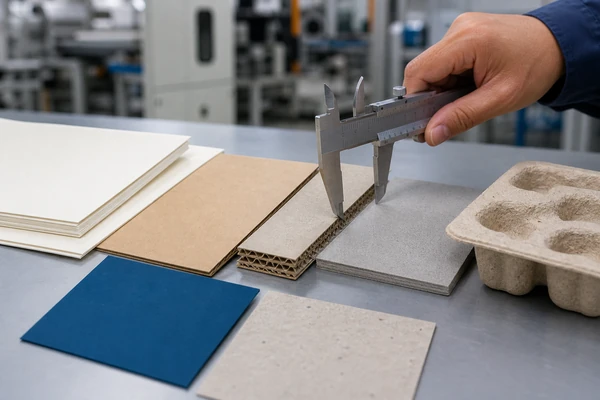
How the three boards differ
| Material | Construction and typical use | Verify on the sample |
|---|---|---|
| SBS (solid bleached sulfate) | Bleached chemical pulp board, often specified for a white premium carton | White point, opacity, ink coverage, crease appearance and finish on both faces |
| FBB (folding boxboard) | Multi-ply construction commonly using a bulkier middle layer. Reverse shade varies by grade | White or cream back, stiffness by grain direction and fit around scores and locks |
| CCNB (clay-coated news back) | Coated face over recycled-fibre board, commonly sold with a darker back | Reverse shade and variation, print holdout, crease cracking and edge appearance |
Terminology varies by region and mill. Holmen’s paperboard reference describes the construction of solid bleached board, FBB and white-lined chipboard. Request the actual grade, surface treatment and data sheet behind the abbreviation on your quote.
Compare caliper and stiffness in both directions
Basis weight in g/m² measures mass per area. Caliper measures thickness. Two boards of the same basis weight can yield different calipers and handle differently on the same die. Specify the caliper needed to fit your insert and packing equipment. Compare bending stiffness data in both machine and cross directions, using comparable test methods. Ask the converter which grain direction will run through the main folds. If the supplier recommends a lighter grade, check that the locked carton stays square and feeds reliably on your line.
Evaluate the artwork on the board and finish you will buy
Use the same design file and a defined color reference on each candidate. Look at the inside panel as well as the outside. A dark reverse can be fine for a sealed retail carton and harder to accept where the buyer sees the tray or flap. Heavy color crossing a crease, an uncoated back and a high-gloss finish can each change what the final piece looks like. Ask for a printed and creased proof when that appearance is part of acceptance.
Do a trial with the actual product. In a light skincare carton, you might prioritize flap retention, a white exterior and a crease without a visible crack. In a window carton, the cutout takes material out of the panel, so the trial also needs to check squareness and display handling. Paperboard coating and fibre type are separate from any food-contact or certification requirement. Request the documents that apply to the actual grade, intended use and market.
Ask for quotes based on a converted carton
Give the converter the dieline revision, product load, finish and expected packing method. Request the proposed board’s mill and grade, nominal basis weight and caliper, stiffness data, coating and reverse shade. Ask for the cost and lead time at your actual SKU quantities, plus the terms for any substitution. Inspect the printed color, scored folds and loaded carton together before releasing the specification. See materials and finishes and folding cartons for the available design choices.
